Sweden’s White-Collar Workers Now Bear the Brunt of Unemployment

Job vacancies in Swedish white-collar occupations have fallen by almost half since late 2022
Something unusual is happening in the Swedish labour market. In previous economic downturns, including the financial crisis and the pandemic, unemployment hit blue-collar workers hardest. This time, the pattern is different. In the downturn that began in 2022, people with post-secondary education accounted for almost two-thirds of the increase in registered unemployment.
A recent report from the Swedish Trade Union Confederation (LO) examines how this development relates to occupations’ exposure to generative artificial intelligence (AI). The analysis combines data from the Swedish Public Employment Service covering 369 occupations with a research-based measure of AI exposure, the Dynamic AI Occupational Exposure index (DAIOE).
The results reveal a clear divide. Between November 2022, when ChatGPT was launched, and July 2026, the number of people registered as unemployed rose by 45 per cent in white-collar occupations while falling by six per cent in blue-collar occupations. Demand for white-collar labour has also weakened more sharply. The number of newly posted job vacancies fell by around 49 per cent in white-collar occupations, compared with 28 per cent in blue-collar occupations.
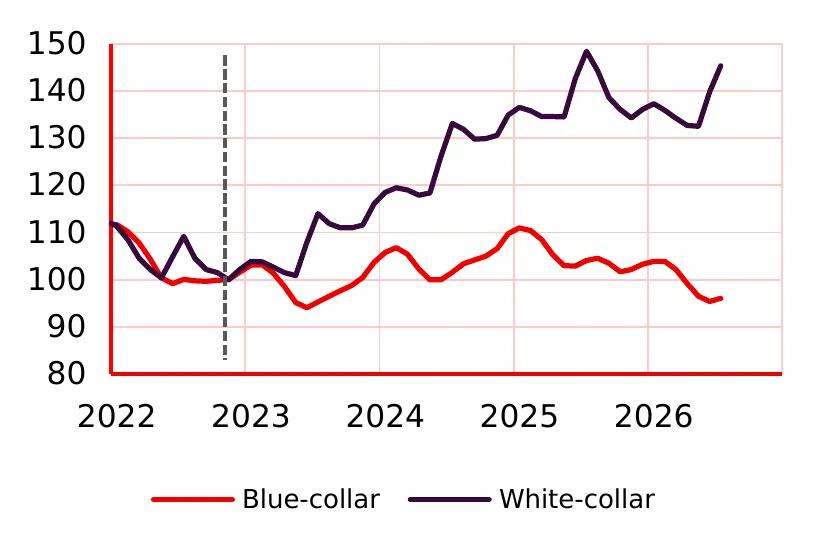
People registered as unemployed: blue-collar and white-collar workers, index November 2022 = 100. Source: Swedish Public Employment Service and our own calculations.
This matters because exposure to generative AI is spread very unevenly across the labour market. The measure used in the report captures the extent to which AI’s capabilities overlap with those required in different occupations. It measures exposure rather than predicting whether a job will disappear.
The 369 occupations are split into four quartiles of roughly equal size, ranging from Q1 (least exposed) to Q4 (most exposed). Around 91 per cent of blue-collar workers are employed in the two least AI-exposed groups. By contrast, around 90 per cent of white-collar workers work in occupations belonging to the two most exposed groups.
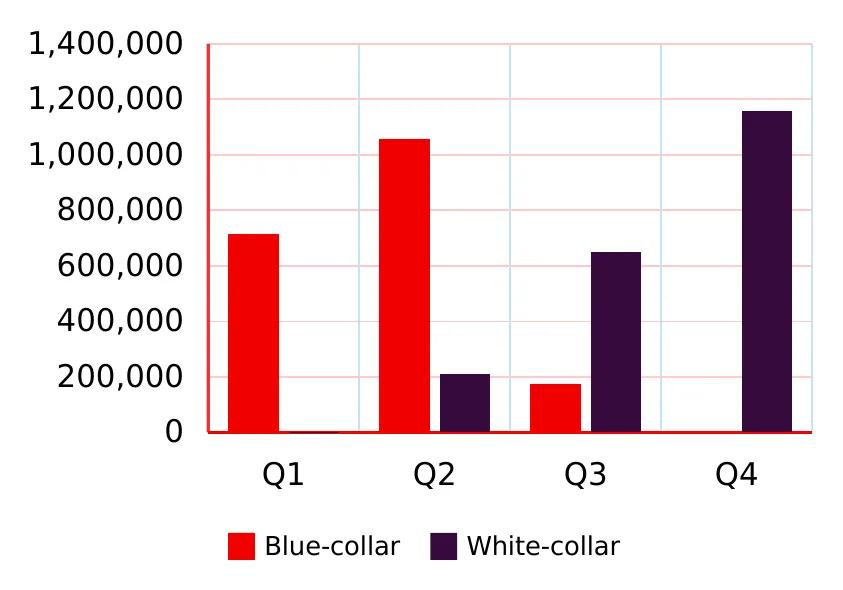
Number of employees by exposure level: blue-collar and white-collar workers. Source: Engberg et al. (2024), Statistics Sweden (SCB) and our own calculations.
The clearest result emerges when unemployment is broken down by both occupational group and AI exposure. In white-collar occupations, the number of people registered as unemployed has increased by around 10 per cent in the second exposure quartile, 41 per cent in the third, and 47 per cent in the most exposed quartile. In blue-collar occupations, the number registered as unemployed is down in the two least exposed groups and roughly unchanged in the third. There are no blue-collar occupations in the most exposed quartile.
The pattern is therefore not simply a difference between blue-collar and white-collar occupations. Even within white-collar occupations, the increase in registered unemployment is considerably greater in groups with higher exposure to AI.
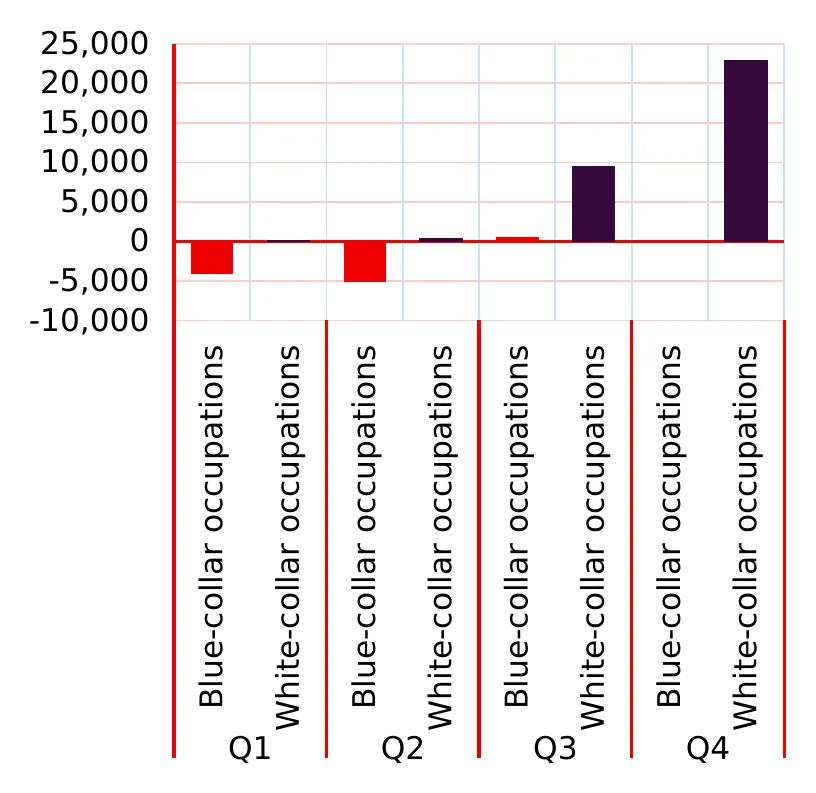
People registered as unemployed by AI exposure and occupational group: number of people, November 2022–July 2026. Source: Swedish Public Employment Service, Engberg et al. (2024) and our own calculations.
These findings should not be read as evidence that AI has caused the rise in unemployment. The breakthrough of generative AI coincided with an economic downturn and monetary tightening. Research from the United States, Sweden, and Finland also gives a mixed picture of AI’s effects on employment. Exposure is not the same as adoption, and neither implies a causal effect.
Nevertheless, the Swedish data point to a change worth taking seriously. The policy response should not be to protect every existing job from technological change. Instead, it should give workers the security they need to embrace change and ensure that they have realistic opportunities to move from old jobs to new ones.
Workers should not have to bear the full economic risk when technology changes the demand for their skills. A strong unemployment insurance system, effective support for workers changing jobs, and good opportunities for retraining can make structural change easier to manage rather than harder to accept.
Skills policy must also start before people lose their jobs. Lifelong learning should become a normal part of working life, and employers need to take greater responsibility for providing it. When technological change creates new tasks, employers should provide the necessary training at their own expense, without undermining workers’ terms of employment or pay.
At the same time, education and training need to offer clearer pathways into occupations where labour demand is high. Vocational education, higher vocational education, and adult training must be able to respond faster when demand shifts between occupations. This is not about assuming that every displaced office worker should become an electrician or move into elderly care. It is about making career changes a realistic option in the middle of working life. Employers, for their part, must ensure that working conditions in occupations with skills shortages are attractive enough.
Trade unions must also have a say in how AI is introduced in the workplace. Decisions about new technologies affect jobs, skills requirements, and working conditions. The lesson is not to resist technological change but to give workers the security, skills, and influence to shape it. Wherever new technology brings productivity gains, those gains must be shared fairly between employers and employees.
Contact
Johan Enfeldt, research officer at the Swedish Trade Union Confederation (LO)
johan.enfeldt@lo.se
Nima Farrahi, economist at the Swedish Transport Workers' Union
nima.farrahi@transport.se